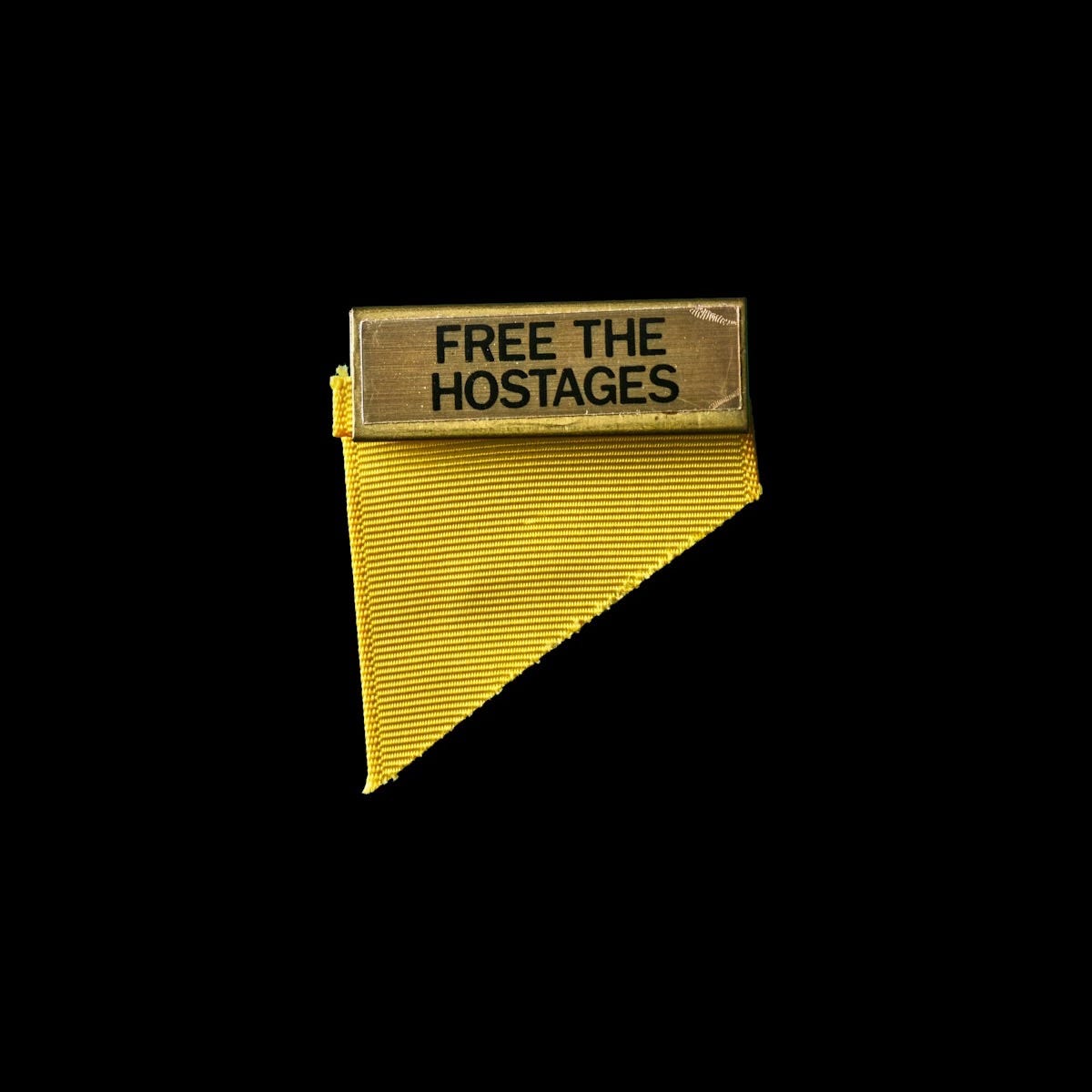
In November 1979, Iranian militants seized the U.S. embassy in Tehran, taking American diplomats hostage. In response, Penne Laingen, the wife of U.S. Chargé d'affaires Bruce Laingen, started a national movement when she tied a yellow ribbon around an oak tree in her front yard. Inspired by the popular 1973 song "Tie a Yellow Ribbon Round the Ole Oak Tree," the yellow ribbon quickly became a ubiquitous symbol of the American public's resolve and hope for the hostages' safe return. Photographed at the Jimmy Carter Presidential Library and Museum.
With Iran back in the news, it feels like the right time to share some of the objects and documents I found at the Eisenhower and Carter presidential libraries that shed some light on the origins of the conflict.
The root of U.S. conflict with Iran can be traced back to the Eisenhower presidency, when the CIA orchestrated the 1953 coup that removed Prime Minister Mohammad Mossadegh and restored the Shah to power. But it was President Carter who presided over the chapter that is still being written today.
Thanks for reading Picturing Presidents! Subscribe for free to receive new posts and support my work.
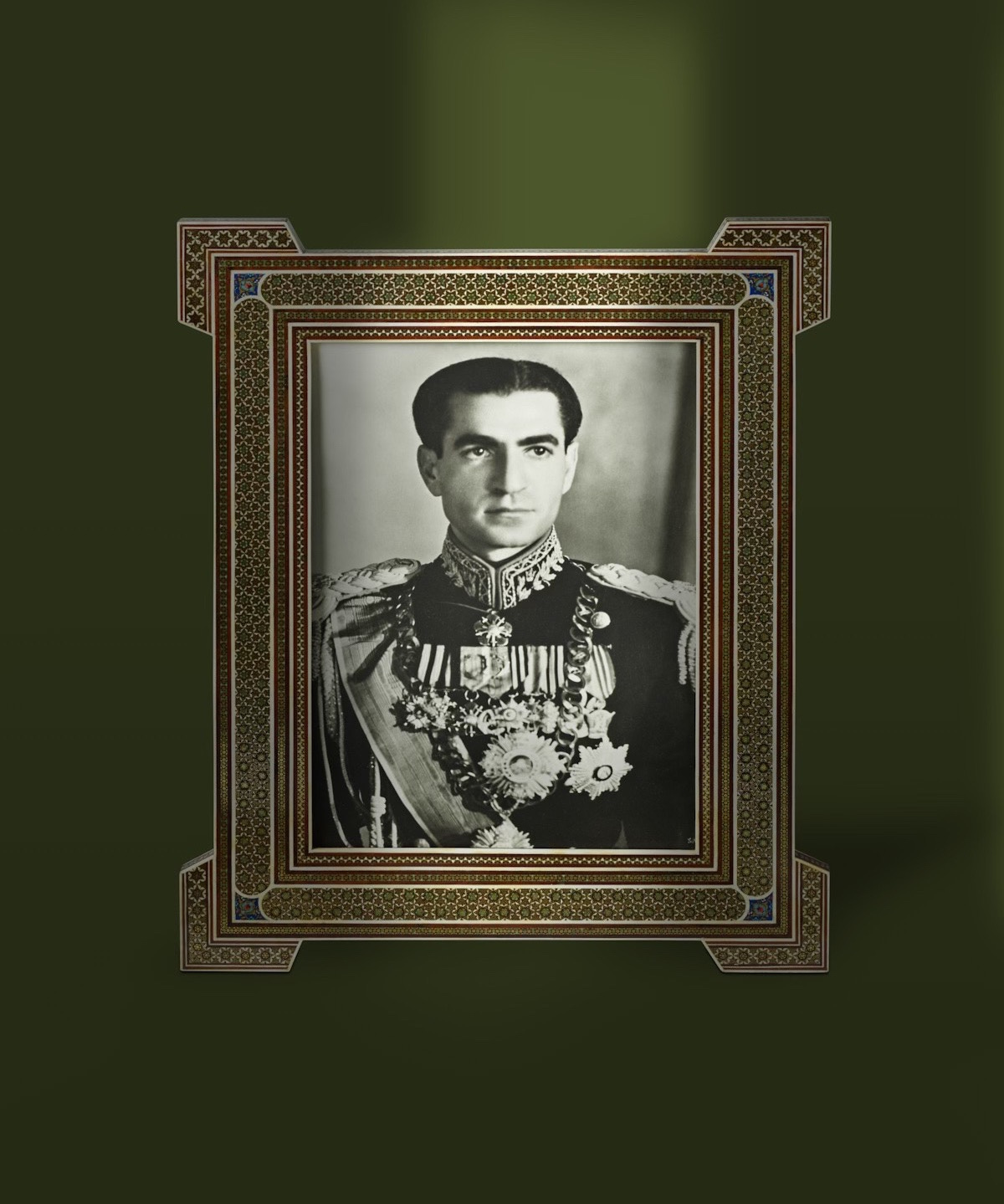
Part of a larger desk set presented by the Shah during President Eisenhower’s December 10, 1959 state visit, the picture frame containing a photo of the Shah is adorned with micro-mosaic. The presentation came amid Cold War alignment between Washington and Tehran following the CIA and MI6-backed coup against Prime Minister Mohammad Mossadegh. The first sitting President to formally visit Iran, Eisenhower’s public support of the Shah demonstrated the country’s importance in America’s strategy of building a ring of allies around the USSR. Photographed at the Dwight D. Eisenhower Presidential Library and Museum
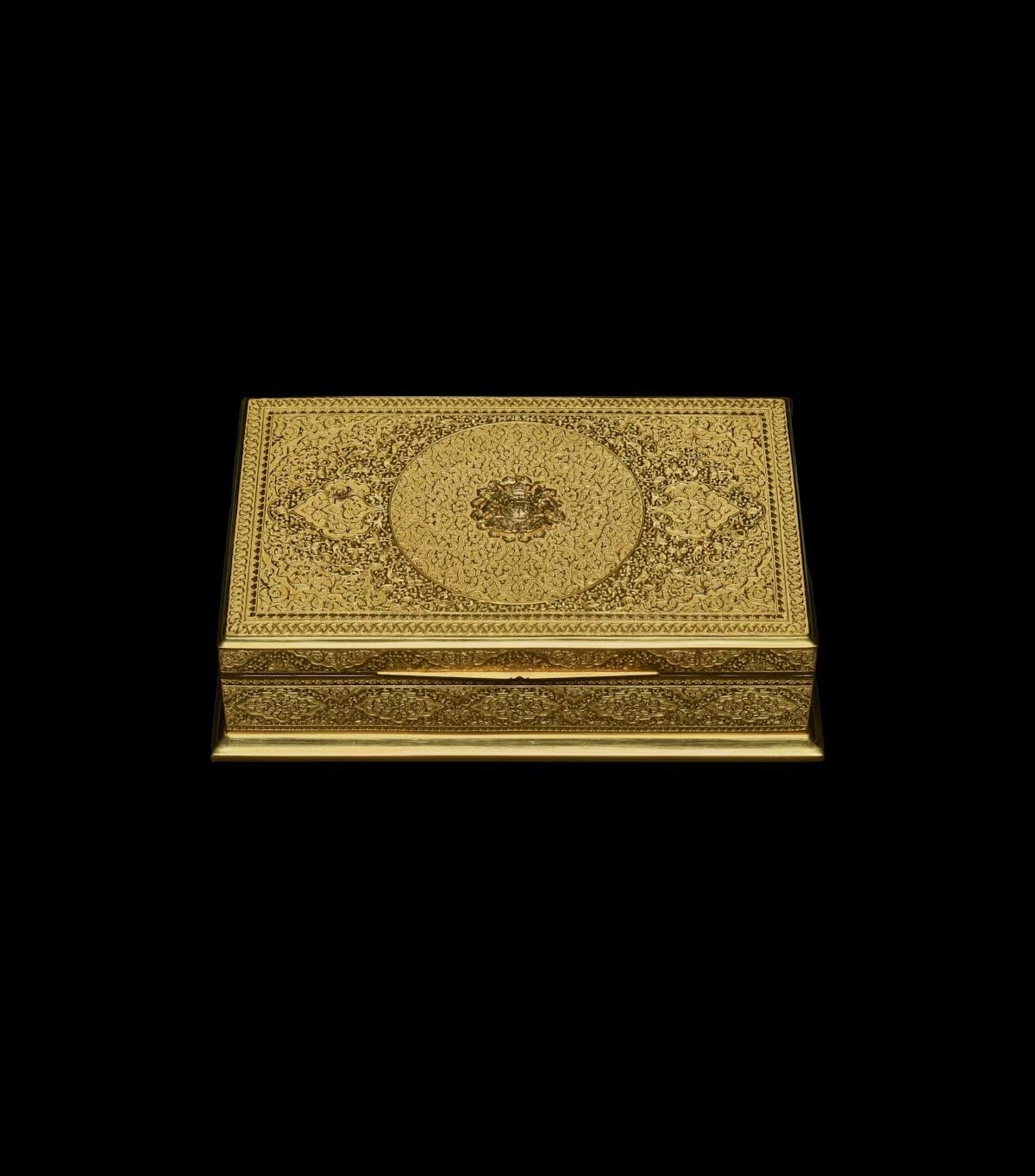
Presented to President Carter during his 1978 state visit to Tehran, this gold box bears the Shah’s lion‑and‑sun crest. In a reciprocal gesture at the State Dinner, Carter praised the Shah’s leadership, calling Iran “an island of stability in one of the more troubled areas of the world.” Given in the final year of the Shah’s rule, the gift marked a high point in U.S.–Iran diplomacy before the Islamic Revolution fundamentally reshaped relations. Photographed at the Jimmy Carter Presidential Library and Museum.
In 1979, amid the chaos of the Islamic Revolution and the seizure of the U.S. Embassy in Tehran, Iranian students took 66 Americans hostage in protest of the Carter administration’s decision to allow the Shah entry into the United States for medical treatment. What was supposed to be a short-lived protest quickly morphed into a far-reaching power play by Iran’s Supreme Leader, Ayatollah Ruhollah Khomeini.
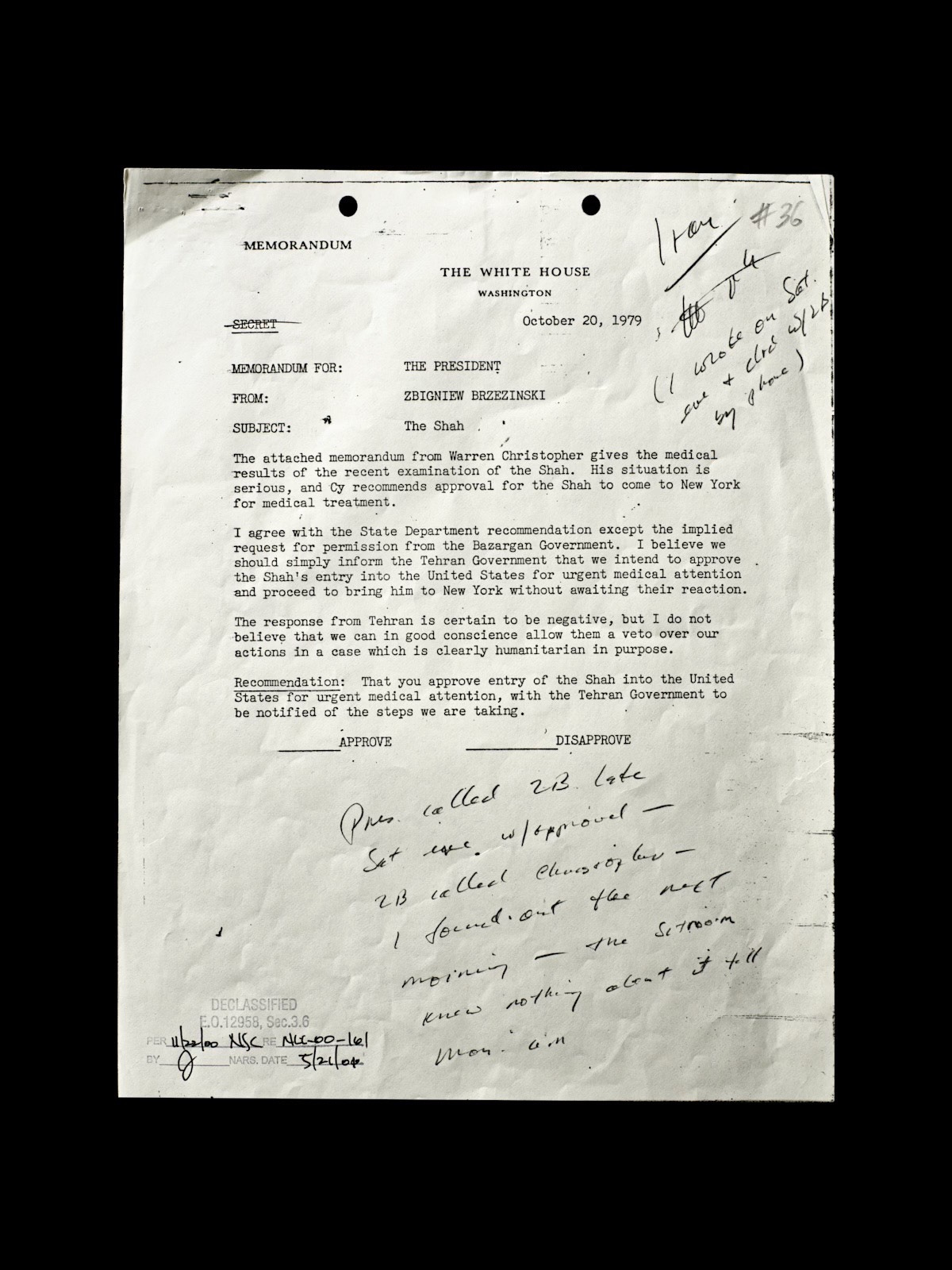
This memo from National Security Advisor Zbigniew Brzezinski recommended that President Carter allow the exiled Mohammad Reza Pahlavi, the Shah of Iran, to enter the United States for urgent medical treatment. Brzezinski noted that while the reaction from Tehran was "certain to be negative," the United States could not grant the new Iranian government a veto over a humanitarian decision. Handwritten notes at the bottom, added by a staff member, chronicled the informal and urgent nature of Carter's approval. Photographed at the Jimmy Carter Presidential Library and Museum.
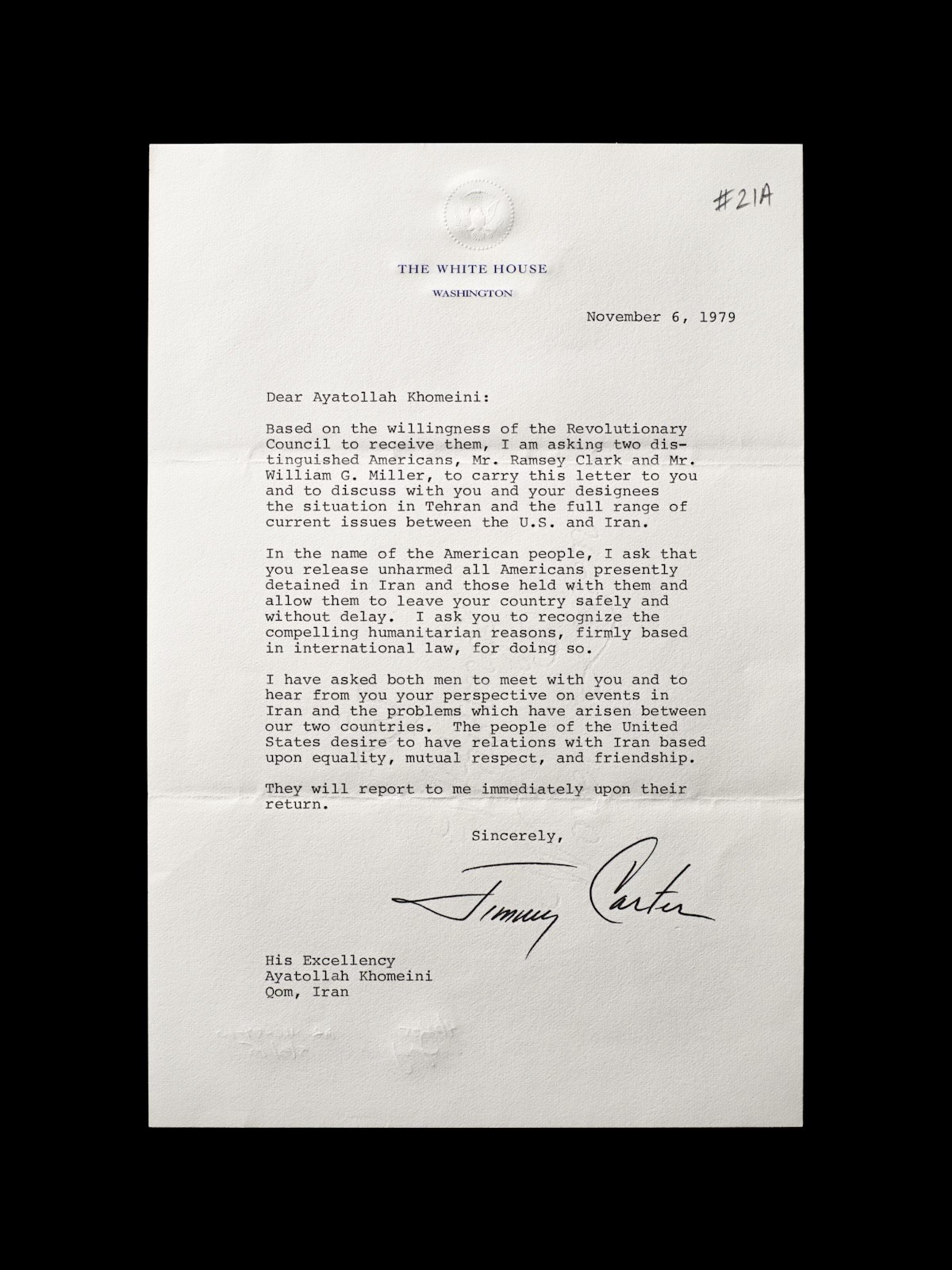
Carter attempted to resolve the crisis peacefully. In a letter to the Ayatollah, he promised to dispatch former Attorney General Ramsey Clark and former U.S. Ambassador to Iran, William Miller, in the hope of negotiating a settlement. The mission collapsed when Iran’s leaders refused to receive Clark and Miller, denounced them as spies, and barred them from entering the country. Khomeini’s unwillingness to negotiate through traditional diplomatic channels foreshadowed the long standoff ahead, one that would result in 52 of the hostages being held in captivity for 444 days.
Written just two days after the U.S. Embassy in Tehran was seized, this letter to Ayatollah Khomeini, was President’s Carter’s first attempt at direct diplomacy with Iran’s new leadership. Photographed at the Jimmy Carter Presidential Library and Museum.
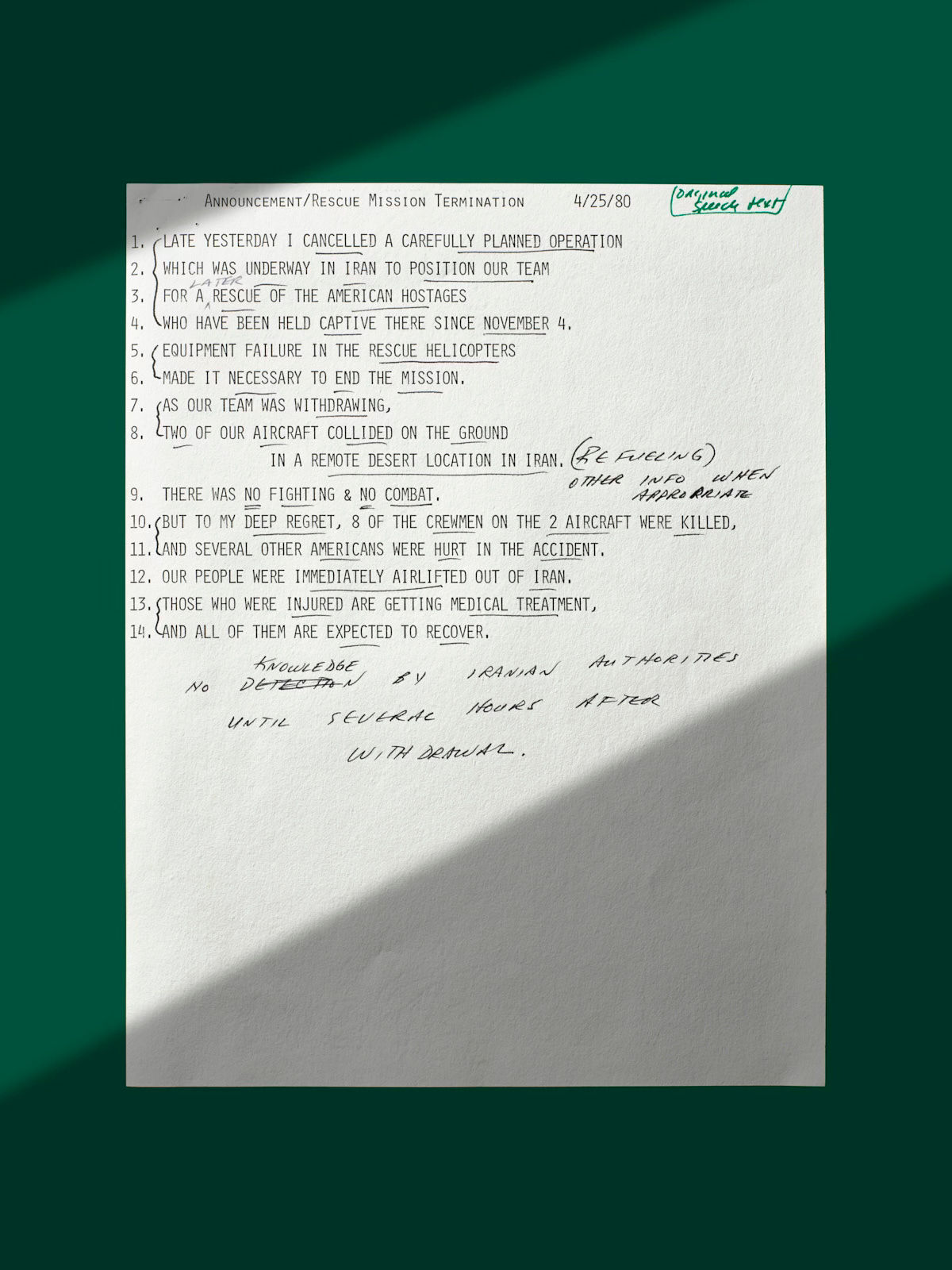
Over the coming year, Carter tried in vain to pressure the Iranians into releasing the hostages by freezing assets and imposing economic sanctions. An aborted rescue attempt ended tragically when a U.S. aircraft collided with a helicopter carrying members of the Army’s elite Delta Force during a refueling operation in the Iranian desert. The situation soon appeared intractable, and the crisis came to define the final stretch of Carter’s presidency—ultimately contributing to his defeat in the 1980 election.
President Carter used this reading copy during his address to the nation announcing the failure of Operation Eagle Claw. The mission to rescue American hostages held in Tehran was aborted after two helicopters experienced mechanical problems, and another collided with a transport aircraft during a refueling operation at Desert One in the Iranian desert, killing eight U.S. service members. Photographed at the Jimmy Carter Presidential Library and Museum.
Carter’s earlier decision to seize Iranian assets and impose sanctions ultimately proved prescient. In late 1980, the measures brought currency-starved Iran to the negotiating table after the start of the Iran-Iraq war. But it would be the election of another president, and a secret promise of arms sales, that ultimately freed the hostages.
I’ll cover how the crisis ended in another post.
Thanks for reading Picturing Presidents! Subscribe for free to receive new posts and support my work.



Amazing artifacts in here.