In Case of Failure
The secret note Eisenhower hoped he would never have to use.

Hi there! In case you missed it, we created some fun presidential bookmarks you can get as a bonus when pre-ordering a copy of POTUS. Ok, now back to the newsletter.
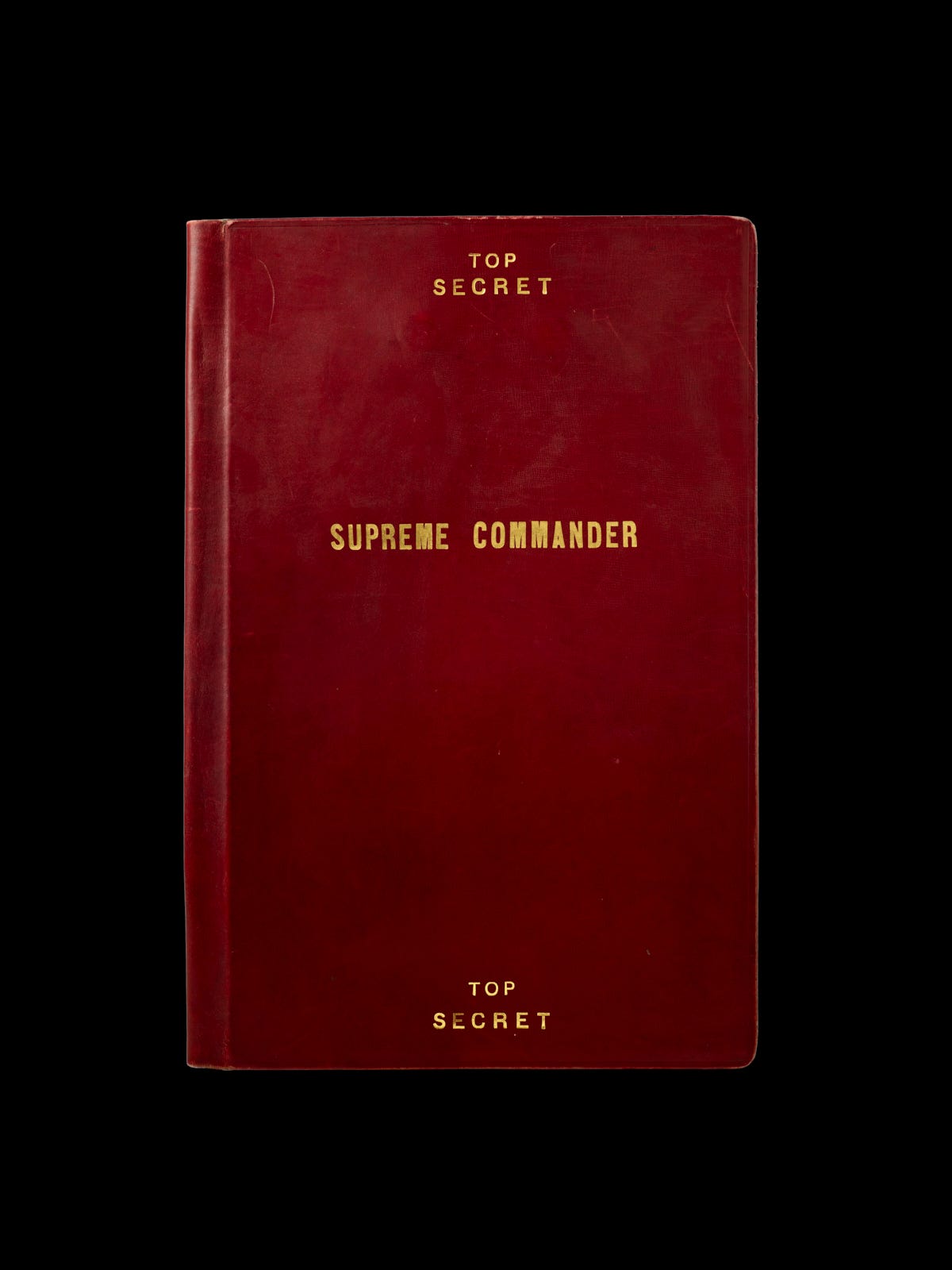
On December 4, 1943, President Franklin D. Roosevelt named General Dwight D. Eisenhower to lead a massive invasion of Nazi-occupied Europe. The assault, known as Operation Overlord, would land more than 130,000 Allied troops on the beaches of Normandy, France.
While planning for the cross-channel invasion had been underway for years, Eisenhower had only a few months to shape its outcome after assuming command of Allied Forces in Europe. He made a point of visiting as many troops as possible and began drafting his now-famous “order of the day” to be distributed to personnel as they boarded their landing craft. What is less well-known is that Eisenhower also drafted a second document—one he hoped he would never have to use.
Handwritten by Eisenhower on June 5, 1944, this second document, was created just one day before D-Day, when the success of the invasion was far from certain. Overlord was—and remains—the largest amphibious invasion in human history. The staggering invasion force consisted of more than 4,000 landing craft, 1,200 warships, and hundreds of support vessels. In addition, nearly 12,000 aircraft were mobilized to bomb German fortifications and drop 23,000 paratroopers behind enemy lines.
The logistics behind assembling and supplying an invasion force of this size required a series of engineering miracles. To land vehicles and supplies on a hostile coast, the Allies invented massive floating harbors and piers, towing them across the channel once the beaches were secured. Undersea pipelines were constructed to deliver millions of gallons of fuel, while dedicated resupply fleets shuttled hundreds of thousands of tons of material to the advancing troops.
All of this had to be executed in absolute secrecy to maintain the element of surprise. To mislead the German high command, Eisenhower deployed elaborate deception campaigns. This included creating a fictional army group using inflatable tanks staged in Southern England across from Pas-de-Calais, France—the narrowest part of the channel. On the night of the invasion, the Allies executed Operation Glimmer, in which Royal Air Force bombers flew in precise geometric circles, dropping strips of aluminum foil to trick German radar stations into seeing a massive, phantom armada. A second diversion was staged to simulate an impending invasion of Norway. The stakes were high. If any of these cover operations failed, the Germans might hone in on the real landing sites and be waiting for the Allies on the beach.
Eisenhower also had to gamble with the one variable he couldn’t control: the weather. The Allies needed a full moon for the paratroopers to see their targets, and a low tide at dawn so the beach assault troops could clear German mines. In June 1944, those perfect conditions aligned on only three days: June 5, 6, and 7. When a massive storm rolled into the English Channel on June 4, Eisenhower was forced to delay the invasion by a day. If the weather didn’t clear by June 6, the entire operation would have to be pushed back two weeks, drastically increasing the odds that Germany would discover the plan. Fortunately, meteorologists spotted a brief window of clearing weather, allowing Eisenhower to give the final, historic order: “Okay, let‘s go.”
Yet, as the troops mobilized, the immense weight of the decision settled in. That’s when Eisenhower sat down and drafted what has since become known as the “In Case of Failure” message.
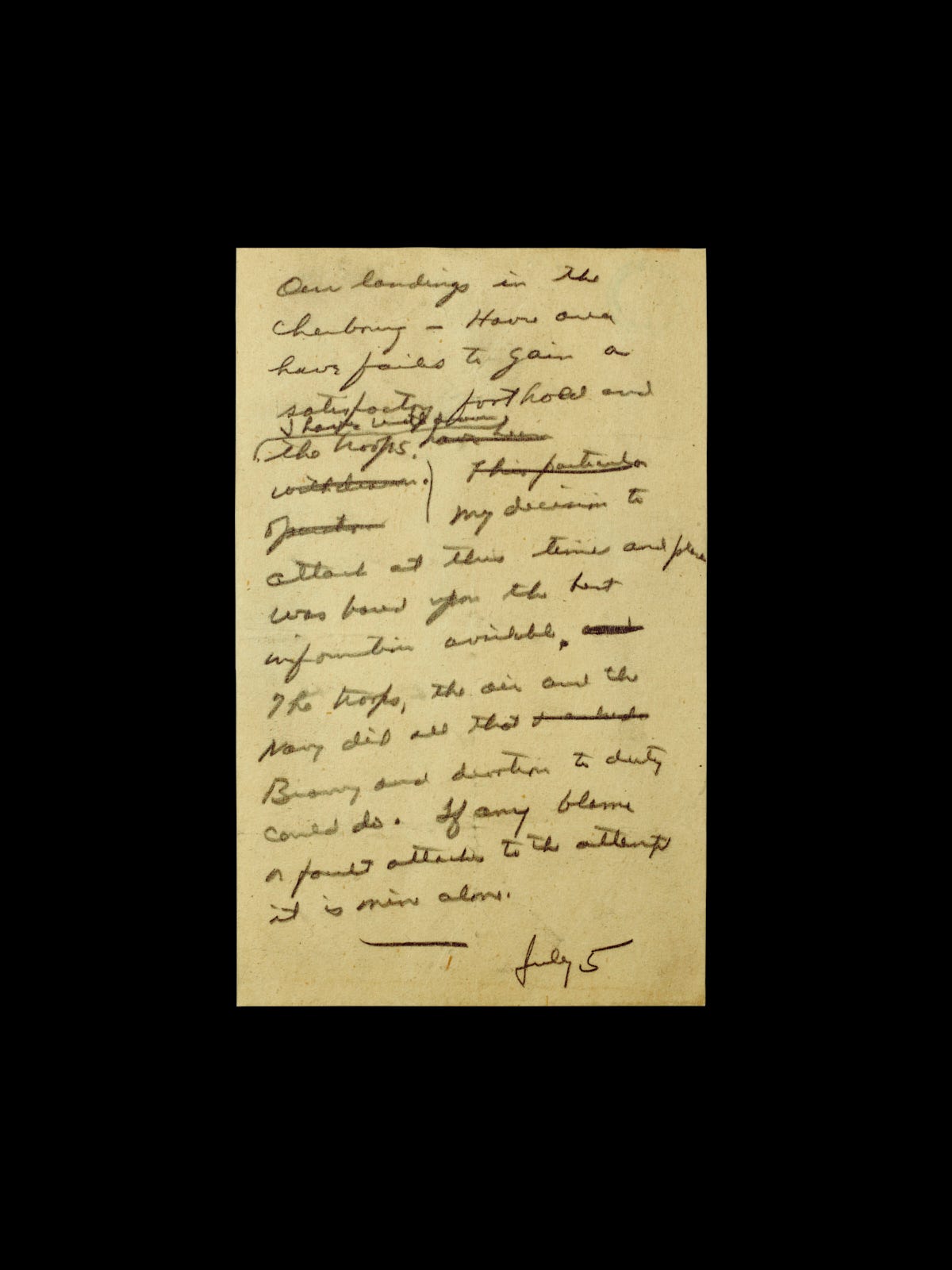
“Our landings in the Cherbourg-Havre area have failed to gain a satisfactory foothold and I have withdrawn the troops. My decision to attack at this time and place was based upon the best information available. The troops, the air and the Navy did all that Bravery and devotion to duty could do. If any blame or fault attaches to the attempt it is mine alone. July 5”
The note was intended to be released to the media in the event the invasion failed and the troops were forced to retreat. What makes it such a powerful historical document is how Eisenhower’s edits reveal his mindset. He actively crossed out passive phrasing, changing “the troops have been withdrawn” to “I have withdrawn the troops.” He replaced “this particular operation” with “My decision to attack.” His deliberate choice of words left no room for finger-pointing. He refused to blame the terrible weather, faulty intelligence, or possible logistical failures. To drive the point home, he underlined the words “mine alone.” The final and perhaps most poignant indicator of just how preoccupied Eisenhower was in that moment is the note’s date: in his exhaustion, he misdated it July 5th instead of June 5th.
Once written, Eisenhower folded the scrap of paper into a small square and tucked it into his wallet. The invasion was a success. Eisenhower never needed the note and completely forgot about it. When he rediscovered it in his wallet weeks later, Eisenhower casually told his naval aide and close confidant, Captain Harry C. Butcher, to discard the scrap of paper. Thankfully Butcher recognized the note’s incredible historical value and chose to save it instead. The note eventually made its way to the Dwight D. Eisenhower Presidential Library, where I was able to photograph it for POTUS.
In all my research across fourteen presidential libraries, I haven’t found anything quite like the “In Case of Failure” note. Today, it is hard to even imagine a political or military leader committing words to paper to assume absolute responsibility in the face of disaster. In that way, Eisenhower was a singular leader, and D-Day a singular event that defined a generation.
If you enjoyed this post, please consider buying my book: